

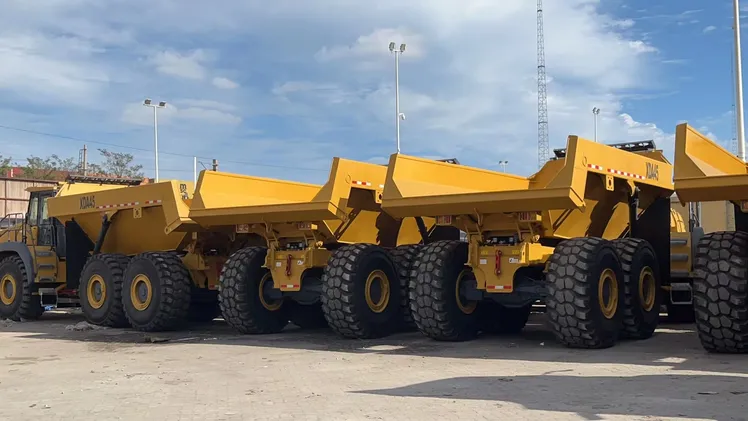
Dumper trucks move the muck that earthworks programmes are measured by: tracked dumpers spreading their load over ground too soft for wheels, and articulated dump trucks (ADTs) hauling bulk at pace over haul roads. The wrong choice shows up as bogged machines or empty haul capacity, shift after shift. EMIS matches the fleet to the ground, the haul distance and the excavator feeding it, coordinated through trusted hire partners, with certification checked before hire, subject to availability.
The two machine families solve different problems. A tracked dumper carries its payload on full-length tracks, keeping ground pressure low enough to cross saturated, reinstated or protected ground that would swallow a wheeled machine, the tool for wetlands, foreshores and early-season earthworks. An articulated dump truck carries far more, far faster, on an articulated chassis built for rough haul roads, the tool for bulk muck-shift once a route exists to run on.
Fleet matching is arithmetic before it is hire. Cycle time over the actual haul distance, payload against the excavator's output, and ground bearing against machine weight together set how many machines a programme needs; get one variable wrong and either the excavator waits or the dumpers queue. Ground conditions also change over an earthworks season, and a fleet specified for August can be the wrong fleet in October.
EMIS runs that matching from the earthworks programme, ground investigation and haul plan, then coordinates hire from trusted hire partners, examination certification, insurance and maintenance record checked before the machines mobilise. Because we hold no fleet, the mix of tracked and articulated machines follows the ground and the programme, and can change with them, rather than defending a yard's utilisation.

The project types and sectors this category most often serves.
Cut-and-fill programmes need ADT capacity matched to the excavator and the haul distance. EMIS sizes the fleet to the cycle time so neither the digger nor the dumpers stand idle.
Wetland, foreshore and reinstated ground stops wheeled plant. We specify tracked dumpers to the bearing capacity and consent conditions so material moves without ground damage.
Flood and rail embankment schemes place fill along linear, often soft, working corridors. EMIS matches the haul fleet to the corridor and coordinates it with trackway where the ground demands it.
Extraction and stockpile operations need reliable ADT capacity over long internal haul roads. We coordinate machines through trusted hire partners with maintenance records checked for sustained duty, subject to availability.
Vetting, specification and lead-time coordination, handled before the product reaches your site.
Cycle time, payload and excavator output are worked before the hire is placed, so haul capacity matches the programme rather than the hire desk's availability.
Examination certification, insurance and maintenance records are verified from trusted hire partners before machines travel, and held ready for the principal contractor.
Holding no fleet of our own, we re-balance tracked and articulated capacity as ground conditions and programme change, the mix serves the season, not a yard.
Typical performance characteristics, full specifications are provided at quotation.
| Tracked dumpers | Typically 1–15 tonne payload, low ground pressure for soft and protected ground |
|---|---|
| Articulated dump trucks | Typically 25–40 tonne payload for haul road operations |
| Selection factors | Ground bearing, haul distance, cycle time and excavator output |
| Certification | Examination reports and maintenance records checked before hire |
See the typical requirements we support, the challenges we help manage, and the ten-step process behind every engagement.
Tell us the requirement and the programme. You will get a specified, priced package from one accountable contact, with the category already selected on the form.
We respond to all enquiries within one business day.