

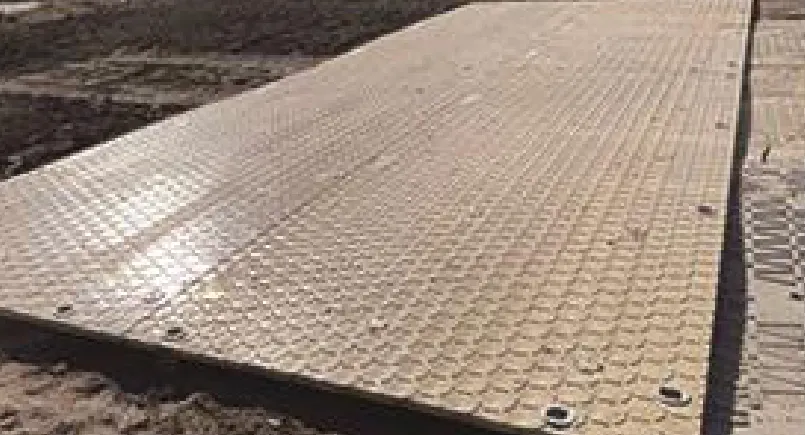
Site access and trackway systems put a temporary road exactly where a project needs one: composite ground-protection mats and heavy-duty trackway panels that carry excavators, cranes and delivery vehicles across ground that would otherwise stop them. EMIS specifies the system to the plant loading and the bearing capacity beneath it, then coordinates delivery, installation sequence and recovery as one package. Access is usually the first thing a site needs and the first thing to go wrong; we treat it as engineering, not an afterthought.
Most schemes do not fail for want of plant, they fail for want of a way to get plant to the workface. Trackway systems solve that with interlocking panels and composite mats laid over soft, wet or protected ground, forming temporary roadways, working platforms and compounds. The ground beneath keeps its integrity, the plant above keeps moving, and when the works finish the road is lifted and the field is still a field.
The engineering lives in the match between load and ground. A panel that carries a delivery van will not carry a tracked crane, and ground pressure that grass tolerates may still overload a buried service or a saturated peat layer. Specifying trackway means knowing the heaviest axle and track loading the route will see, the bearing capacity of the ground under it, and how the route ties into the public highway at the site entrance.
EMIS specifies the system from the site access plan, ground conditions and plant schedule, sources it from vetted trackway suppliers, and coordinates the logistics that make trackway work: delivery in the right laying order, installation plant, and recovery when the route is no longer needed. Environmental and third-party constraints, root protection areas, utility easements, landowner agreements, are built into the routing rather than discovered by it.
The project types and sectors this category most often serves.
Linear schemes cross fields, verges and protected ground for kilometres. EMIS specifies trackway to the heaviest plant on the route and coordinates phased delivery so the road advances with the works.
Heavy plant needs a working platform with known bearing capacity, not an assumption. We specify mats and panels to the outrigger and track loading so the lift or pile stands on documented ground.
Wetland, foreshore and habitat sites demand access that leaves no lasting trace. EMIS matches ground protection to the consent conditions so plant reaches the workface with the evidence trail intact.
Substation, wind and cable landfall works are often in exactly the places roads are not. We coordinate trackway with the delivery programme so abnormal loads arrive over a route built for them.
Vetting, specification and lead-time coordination, handled before the product reaches your site.
The system is specified to the heaviest axle and track loading on the route and the bearing capacity beneath it, a documented match, not a hire-desk assumption.
Trackway arrives as a logistics exercise: panels in the sequence the route is laid, installation plant coordinated, recovery planned, one programme from first panel to last.
Root protection areas, easements and consent conditions are engineered into the routing, with supplier certification and load data held ready for the principal contractor.
Typical performance characteristics, full specifications are provided at quotation.
| Panel types | Aluminium trackway panels and heavy-duty composite mats |
|---|---|
| Load ratings | Systems typically rated for plant up to 150 tonnes gross, subject to ground assessment |
| Applications | Temporary roadways, working platforms, compounds and pedestrian routes |
| Ground types | Soft, wet, sloping and environmentally protected ground |
See the typical requirements we support, the challenges we help manage, and the ten-step process behind every engagement.
Tell us the requirement and the programme. You will get a specified, priced package from one accountable contact, with the category already selected on the form.
We respond to all enquiries within one business day.