

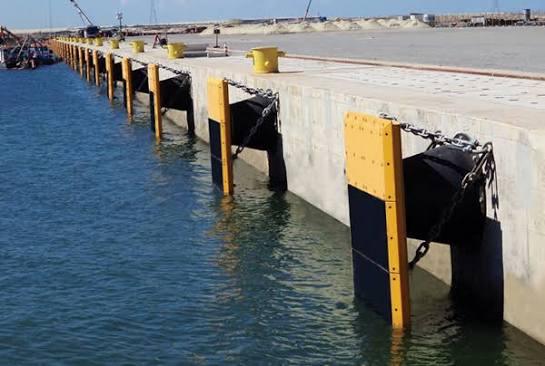
Marine fenders are the energy-absorbing systems that stand between a vessel's hull and the structure it berths against. Floating pneumatic and foam-filled units serve ship-to-ship and exposed berths; fixed rubber profiles suit quays, locks, terminals and tugs. EMIS specifies the fender type, size and arrangement to the vessel class, berthing energy and approach conditions, then sources it from vetted manufacturers with type-approval and test documentation attached.
A fender's job is simple to state and unforgiving to get wrong: absorb the kinetic energy of a berthing vessel and return it at a reaction the hull and the structure can both live with. Floating pneumatic fenders, supplied as sling types or dressed in chain-and-tyre nets, are the workhorses of ship-to-ship transfer and exposed berths, riding with the tide and taking heavy compression without damage. Foam-filled fenders offer similar duty with a closed-cell core that cannot deflate, faced in a reinforced polyurethane skin. Both are supplied in diameters up to around 4.5 metres for the largest vessel classes.
Fixed rubber fenders answer the everyday duty at quays, terminals, locks and berths: cell and cone units for high-energy berths, arch and cylindrical profiles for general quay walls and workboats, D-section and M-section extrusions for pontoons and tugs, and roller fenders for lock entrances and dry-dock approaches, typically faced with low-friction UHMWPE pads that take the wear the rubber should not. Tug and workboat fendering is its own discipline, wrapping bow and sides in profiles that push and berth all day.
Fender selection starts from the design vessel, the approach velocity and angle, the tidal range and the structure behind the fender, then works back to a type, size and spacing. EMIS takes the berthing analysis or helps establish it, specifies the system, and sources from vetted fender manufacturers with type-approval and certification documentation supplied at quotation. The berth gets the energy absorption it was designed for, with the evidence the harbour engineer needs.

The project types and sectors this category most often serves.
Cell, cone and arch fender systems for commercial quays and terminals, specified to the design vessel and renewal programme and delivered with fixings and facing pads as one package.
Floating pneumatic fenders, sling type or chain-and-tyre net, sized to the vessel pairing and sea state, for STS operations, offshore terminals and berths where fixed fendering cannot work.
Cylindrical, D-section and specialist tug fendering wrapped to the hull form, for craft that berth and push as their daily duty rather than as an event.
Roller and wheel fenders guiding vessels through lock entrances and dock approaches, with rubbing strips and facing pads protecting the masonry and the hull.
Fender systems for naval berths, patrol craft pontoons and public-sector jetties, supplied with the traceability and certification the asset register requires.
Vetting, specification and lead-time coordination, handled before the product reaches your site.
Design vessel, approach velocity, tidal range and structure stiffness drive the selection, fender type, size, grade and spacing are engineered before anything is priced.
Fenders are sourced from manufacturers vetted for testing and quality record, and supplied with relevant type-approval and certification documentation for the harbour engineer.
Fender units, chains, fixings, facing pads and spares arrive as one coordinated delivery, timed to the possession, the tidal window or the vessel programme.
Indicative capability ranges, full specifications and performance data are provided at quotation.
| Pneumatic fenders | Sling type or chain-and-tyre net, supplied in diameters up to ~4.5 m and lengths to ~12 m |
|---|---|
| Foam-filled fenders | Closed-cell foam core with reinforced polyurethane skin; multiple energy grades to suit the duty |
| Rubber fender profiles | Cell, cone, arch, cylindrical, D/M-section and roller types, with UHMWPE facing pads |
| Energy absorption | Selected to vessel class and berthing analysis, from workboat duty to the largest commercial berths |
| Certification | Supplied with relevant type-approval and certification documentation |
See the typical requirements we support, the challenges we help manage, and the ten-step process behind every engagement.
Tell us the requirement and the programme. You will get a specified, priced package from one accountable contact, with the category already selected on the form.
We respond to all enquiries within one business day.